Early Passenger Tickets
In the age of sail, passage was negotiated with the ship's master, often with no printed ticket at all. As steamship companies introduced timetables in the nineteenth century, they also introduced standard fares and printed tickets, frequently divided into first, second and sometimes third class. Railway companies used small card tickets, the Edmondson ticket, which were dated with a press — a system also used on many railway ferry connections.
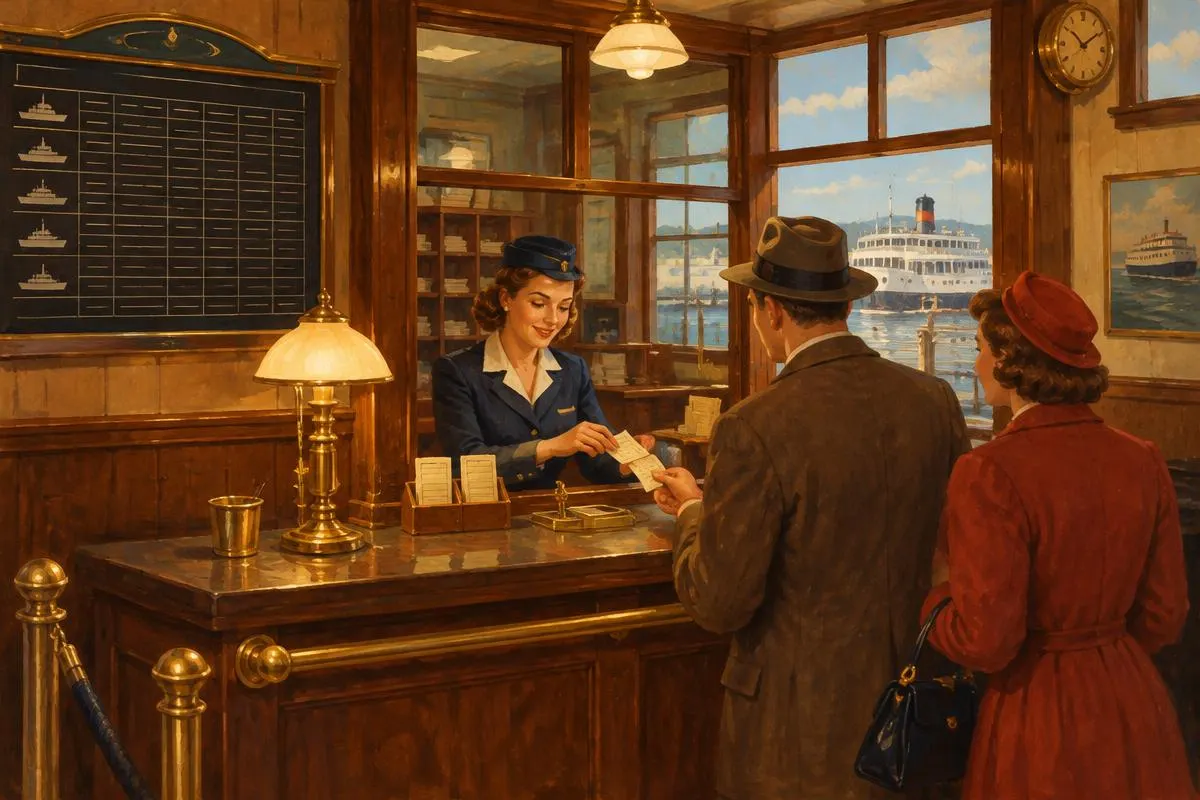
Ticket Offices at Ferry Terminals
For most of the twentieth century, the terminal ticket office was where travellers bought their passage. Clerks consulted printed fare tables, issued paper tickets and collected payment in cash, often in several currencies. Railway passengers bought through tickets at their departure station, covering both train and ferry. Travel agencies and motoring clubs also sold tickets and offered guidance on routes.
The Introduction of Advance Reservations
As car ferries grew popular, demand in summer often exceeded capacity. Operators introduced advance reservations so that drivers could secure a place on a particular departure. Bookings were made by letter, telephone or through agents and recorded in ledgers or on planning boards showing the available deck space.
Computerized Ferry Bookings
Airlines pioneered computerised reservation systems in the 1960s, and ferry and railway operators gradually followed in the 1970s and 1980s. Central computers allowed agents in different cities to see availability in real time, reducing overbooking and enabling more complex fare structures.
Online Ferry Tickets
The arrival of the internet in the late 1990s allowed customers to book directly. By the 2000s, most major operators offered online ferry tickets for Denmark, Germany and Sweden. Today, travellers searching for ferry tickets to Denmark, ferry tickets to Germany or other Baltic Sea ferry tickets generally book through operators' websites and apps. Those looking for Scandlines tickets online should use the operator's official website, not third-party pages claiming to be official.
Modern Car Ferry Bookings
Car ferry fares usually depend on the vehicle rather than only on the number of passengers. Categories often distinguish cars by length and height, and add separate classes for motorhomes, caravans, trailers, motorcycles and lorries. Many terminals now use automatic number-plate recognition to match a vehicle to its booking.
One-Way and Return Tickets
Operators have long offered single (one-way) and return tickets. Historically, return tickets were often cheaper than two singles, encouraging round trips. Some operators also offer short-stay returns, day-trip fares or commuter products. Conditions vary by operator and change over time.
Flexible Ferry Tickets
Flexible fares allow changes to the departure time or date, sometimes at a higher price than fixed-departure fares. On short, frequent routes, some tickets allow travellers to take any departure within a given period. Always read the specific conditions before booking.
Combination Tickets
Combined products — for example a ferry crossing plus a bridge passage, or a ferry plus rail journey — have appeared at various times. Their availability and conditions change, so check with the operators concerned. See our article on Denmark, Sweden and the Øresund for background.
How Modern Travellers Find Ferry Tickets
For accurate, up-to-date information, consult the ferry operator directly. The official operator website is the most reliable source for:
- Ferry prices, which vary by season, vehicle and demand.
- Departure schedules and timetable changes.
- Route availability, including seasonal and suspended routes.
- Ticket categories such as standard, flexible and return fares.
- Booking conditions, cancellation rules and check-in times.
Current tickets
For current Scandlines routes (such as Puttgarden–Rødby and Rostock–Gedser), visit the operator directly:
Official Scandlines website (external) →
External link. Scandinec is not affiliated with Scandlines and receives no commission.
Important notice
This website is a historical and educational information resource. We do not sell ferry tickets, process reservations or accept payments. For current tickets and bookings, please contact the relevant ferry operator.