Historical Connections Across the Øresund
The Øresund (in English, the Sound) separates Zealand in Denmark from Scania in Sweden. At its narrowest point, between Helsingør and Helsingborg, it is only about four kilometres wide. For much of its history both shores belonged to the Danish crown: Scania was Danish until the Treaty of Roskilde in 1658. Kronborg Castle at Helsingør guarded the strait and enforced the Sound Toll from 1429 until 1857.
Maritime Trade Between Denmark and Sweden
The strait has always been both a border and a bridge. Scanian herring markets attracted merchants from across Europe in the Middle Ages. After 1658, trade continued despite the new border, and in the nineteenth century growing towns on both sides — Copenhagen, Malmö, Helsingborg, Landskrona — developed close commercial and family ties.
Passenger Ferries Across the Øresund
Regular steamships connected Copenhagen and Malmö from the nineteenth century. In the twentieth century, hydrofoils and fast catamarans offered quick city-to-city crossings, while car ferries linked Dragør and Limhamn and other Øresund ports. Railway ferries connected Copenhagen and Malmö, and Helsingør and Helsingborg, giving Sweden direct rail links with Denmark and the continent.
Helsingør–Helsingborg Ferry History
The crossing between Helsingør and Helsingborg is one of the oldest and busiest ferry routes in the world. Boats have crossed here for centuries; a railway ferry service started in 1892. In the second half of the twentieth century, several companies competed on the route, and departures ran every few minutes at peak times.
For a period after 1998, Scandlines operated ferries on Helsingør–Helsingborg. That operation was later separated from Scandlines, and the route has since been run by other companies under different names. Scandlines does not currently operate the Helsingør–Helsingborg route; travellers should check the current operator's own website for timetables and tickets.
The Construction of the Øresund Bridge
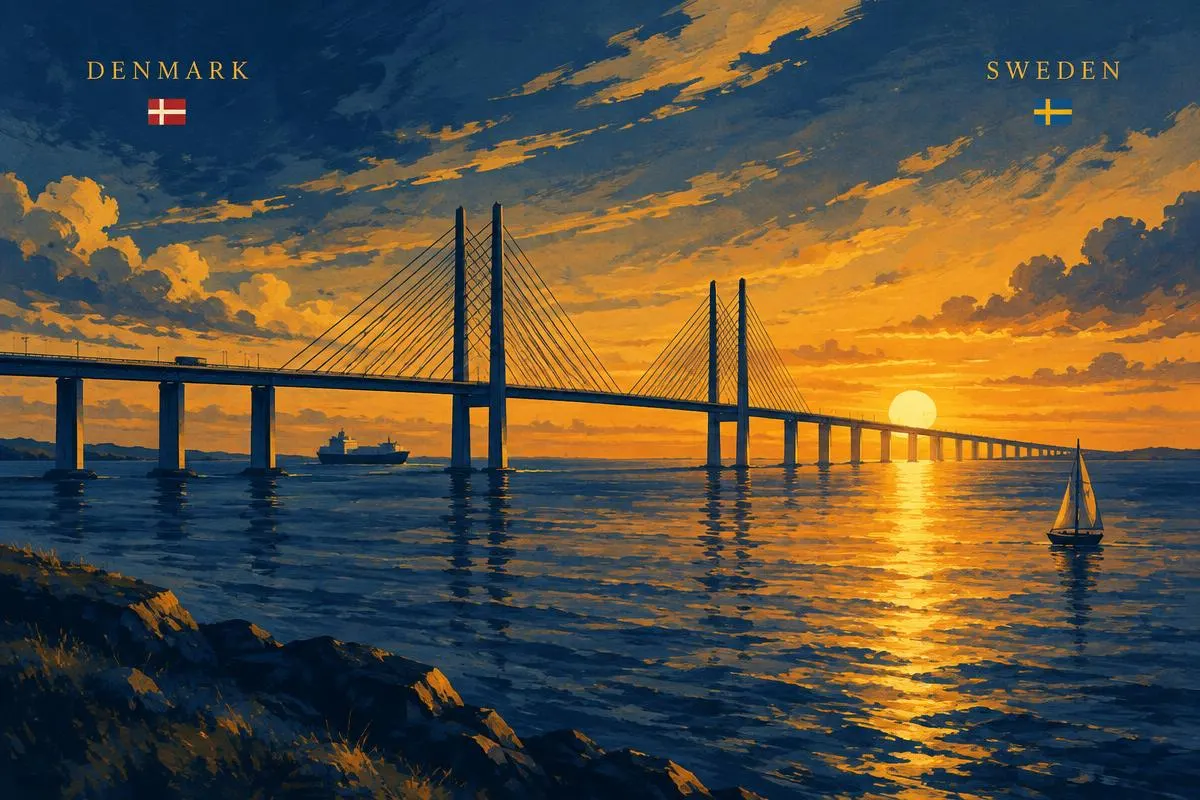
The idea of a fixed link across the Øresund was debated for most of the twentieth century. Denmark and Sweden signed an agreement in 1991, and construction began in 1995. The link, about 16 kilometres long, consists of a tunnel from the Danish coast near Copenhagen Airport, the artificial island of Peberholm and a cable-stayed bridge to Sweden. It opened on 1 July 2000, carrying both a motorway and a railway.
The bridge transformed the region. Daily commuting between Malmö and Copenhagen became common, and the Øresund region began to function in many ways as a single labour market. Ferry traffic between Copenhagen and Malmö declined sharply, while the Helsingør–Helsingborg ferries remained busy.
Ferry and Bridge Travel
Ferries and bridges serve different needs. The bridge offers speed and continuous operation; ferries offer a short break, avoid motorway congestion and serve routes where no fixed link exists. Many travellers between Germany and Sweden use both: a ferry across the Baltic and the Øresund Bridge into Sweden.
Travelling from Germany to Sweden via Denmark
Geographically, a journey by ferry from Germany to Sweden via Denmark typically combines a crossing such as Puttgarden–Rødby or Rostock–Gedser with a drive across Zealand and the Øresund Bridge to Malmö — the classic "Puttgarden–Rødby and Øresund Bridge" or "Rostock–Gedser and Øresund Bridge" itineraries. Alternatively, direct ferries between German and Swedish ports, such as the historic Sassnitz–Trelleborg "King's Line" (from 1909) or routes from Travemünde and Rostock to Trelleborg, avoid Denmark altogether.
Combination Tickets
As traffic between Germany and Sweden grew, operators and bridge companies developed combined offers bundling a ferry crossing with passage over the Øresund Bridge. The availability, conditions and prices of any ferry and bridge ticket for Sweden change over time, and Scandinec cannot confirm whether a particular Denmark–Sweden combination ticket is currently offered. Please check directly with the ferry operator or the Øresund Bridge operator.
Important notice
This website is a historical and educational information resource. We do not sell ferry tickets, process reservations or accept payments. For current tickets and bookings, please contact the relevant ferry operator.
The Future of Scandinavian Transportation
The Fehmarn Belt tunnel, under construction, will create a direct rail and road link between Germany and Denmark, and together with the Øresund Bridge it will form a fixed corridor from Hamburg to Malmö. Electrification of ferries, increased rail capacity and proposals for further Øresund links show that the region's transport network is still evolving.